Wolfram API
A mini project idea, 15 June 2021
"Wolfram|Alpha is the world's first and only computational knowledge engine"
My mini idea could be built using Python in about 10 minutes. I would like to use the Wolfram|Alpha Simple API using JavaScript or React and I anticipate it will take significantly longer. There is a JavaScript library available online. It should also be noted that Node.js backends to simply call the Wolfram|Alpha API. This simple API retrieves images of complete Wolfram|Alpha result pages. To access specific data, one would need to use a subscription API.
A plain language sample query, "Who lives in a pineapple under the sea?" would return a sample image of the complete Spongebob SquarePants result page:
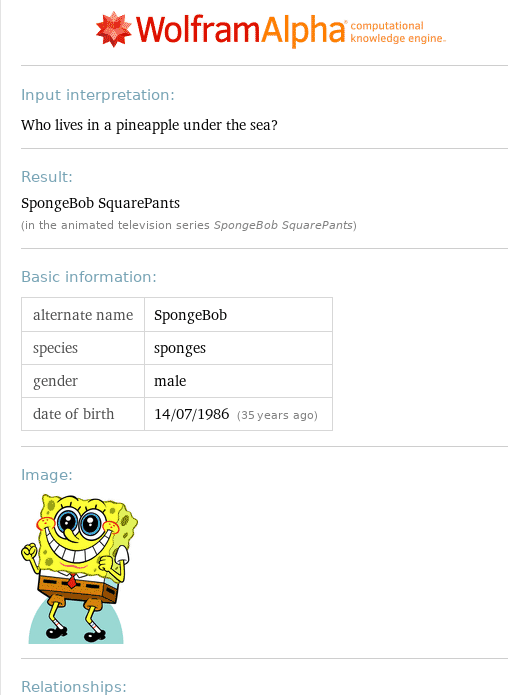
The query returns a promise and it does take quite some time to get data. The following dancing Spot gif could make for a better user experience whilst the data is being retrieved:
Given that the simple API does not have the same level of library access as the paid API subsciriptions, it is possible that the user will not get an answer to their query. In this event, I prefer the following gif:
This proposed idea is essentially a one page simple application that would serve the dual purpose of using a free version of a really cool Wolfram API with a little bit of gif fun.
If you feel for the kicked robot, I encourage you to read more about these creations at Boston Dynamics.
Learning Leisure
Books and Graphic Novels, 14 June 2021
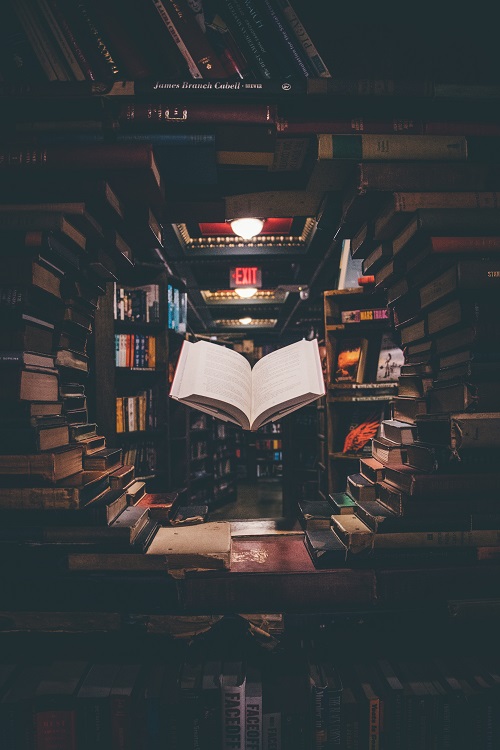
I love books. I love touching the pages and flipping through. I love seeing them on the shelf, displayed as passionate works of art and collections of knowledge and imagination. I do read e-books and research online databases and I love those too (my browser history is littered with journal articles and trace my tumble down the rabbit hole of whatever topic drew my curiosity last). But for leisure, nothing compares to a hardcopy book in all of its paper glory. My shelves are filled with everything from fiction to economics. But my favourite section is reserved for graphic novels, comics and manga.
I read a lot during my legal career, but rarely for leisure. Reading for leisure was an activity that I almost had to re-learn after graduating from university and grinding the first years of my professional career. I don’t remember how I discovered graphic novels, but it may have been during this time when I was starved from creativity and cherished every moment of visual stimulation. I always retained a nostalgia for the comics that I read during my childhood (including Archie and Harvey Comics). If memory serves, my first graphic novel was V for Vendetta. And whilst many graphic novels have been adapted to screen, there is something magical and precious about the original creative wonders where story meets static pictures. Jeff Lemire’s Essex County has illustrations that convey so much character intimacy that words are rendered almost unnecessary. And to lighten the mood, I love Image comics and the colourful illustrations that spread across the pages. I must admit, that I have yet to read some volumes of Brian Vaughan and Fiona Staples’ epic space opera, Saga, and I am saving those for a rainy day with Milo.
There is leisure in learning when you learn because you want to, rather than when you feel as though you have to. It is also inevitable that there will be times to do what you must because you have responsibilities and obligations. During these inevitable times, it is important to learn to enjoy leisure again. And if you find yourself short on time when you want to read a book or watch a movie, I suggest trying a graphic novel.
Future Proof
Science and Technology, 10 June 2021

Every few years I re-read my favourite book, The Little Prince by Antoine de Saint-Exupery. Do not be fooled by the children’s illustrations. This little book contains wisdom about life and human nature that are so valuable that I remind myself repeatedly because I do not want to become the man counting “those little golden things that make lazy people daydream”. Dare to dream! It is a magical thing. Lucid dreaming, day dreaming, imagination, envisioning change, whatever, it is all magical so hold on to it. Whether you fly through space or surf the internet, I urge you to explore new worlds that you don’t know much about at all.
My twitter posts give me away. I have been reading quite a bit about science and technology as of late. I’m not obsessed but I am fascinated. There is so much to learn!
I believe it was during an episode of my favourite podcast, Command Line Heroes, where I first heard about the open-source Mars rover plans. Yes, I do want to build a rover and I want a Boston Dynamics Spot. Then I remind myself that these are expensive toys to build and buy and perhaps I should fulfill some more adulting obligations first.
I decided to change careers. A STEM career. I signed up for a coding bootcamp. I get to learn coding and build projects. I get to solve problems and make pretty things. I get to imagine and create. I enjoyed learning CS fundamentals math and reading about algorithms, which was unexpected. I get to see colour! It feels like an awakening and I am excited.
When I first read about the 4th industrial revolution and how many new careers will be born and how many will become redundant, I was excited. Things I could not yet fully understand, or maybe even imagine, where going to change the world in my lifetime. I made the mistake of attempting a discussion about this with a lawyer. Their perception was one of fear and robots stealing all jobs. Mine was that science and technology can give us more precious time (a resource exhausted within mere decades and then we expire). Science and technology can give us time. Time to dream. Time to learn. Time to be curious and explore. Time to achieve and accomplish more. Time to be and express creativity.
Fear not the future, dream how to build a future that is better than what we have now and maybe inspire others to upskill and prepare for all those wonderful careers that don’t exist yet.
Live or Streaming
Entertainment during a Pandemic, 21 March 2021
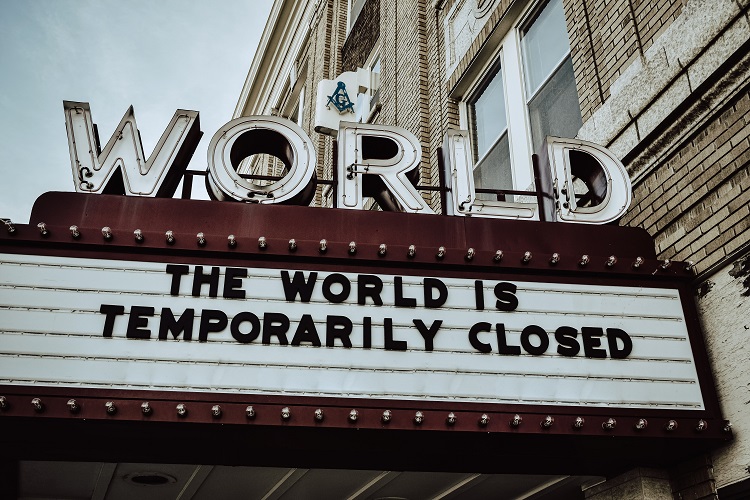
I am still pondering this post. For now, please do enjoy this image.
Splash Color
Color Palettes, 13 January 2021

To oversimplify, our eyes distinguish colours based on the retina’s colour receptor cells’ sensitivity to short, middle and long wavelengths – let’s call them blue, green and red (apologies again for the oversimplification). This is sometimes confusing to school students who read about this in text books (where they are also shown a picture of white light hitting a prism and splitting into a rainbow) and then walk into their art class where they are told that they can mix any colour using only primary colours (blue, red and yellow) and maybe white (but don’t touch black if you can avoid it!).
The science and art of colour are interesting and as I always say, if that interests you, definitely go read more about it. Also experiment with it.
I am lucky because I was privileged to have art supplies from as far back as my memories go. I also took art all through high school and loved it (the history and the practical). Resultantly, I never really had to give much thought to colours and often just follow a natural feel for it.
Now that I am learning to build websites, that colour theory and feel is suddenly very useful. Unfortunately, not everyone had the privilege of growing up with art supplies and art classes. When I see complimentary colours clashing and exploding on websites, to the point where it hurts my eyes to look, I just think – please read up about complimentary colours! Essentially, these are colour pairs at opposite sides of the colour wheel (red and green; blue and orange; yellow and purple etc). They really POP! And stand out. They are eye catching! These pairs can work really well to catch attention but too much mishandled can be horrible to look at and is just too much.
As is often the case, internet to the rescue! You don’t have to read up about colour or even have a feel for it. You can quite literally use one of the countless websites online that will generate a colour palette for your website or even allow you to drop a photo to enable the website to generate a colour palette based on your submitted image. Web developers can assemble websites with good colour palettes merely by using free resources online. So, the next time you are stuck on picking colours for your website or merely want some inspiration or time saving tools, definitely explore some of these websites.